
Buying a Home
Temporary Rate Buydowns: Lower the Payment Without Cutting the Home Price
By Nathan Williams · August 25, 2026 · 6 min read
When buyers and sellers negotiate, the conversation often immediately becomes about price.
Buyer wants $10,000 off.
Seller doesn't want to reduce the price.
Negotiations stall.
But sometimes there is another way to use those same dollars.
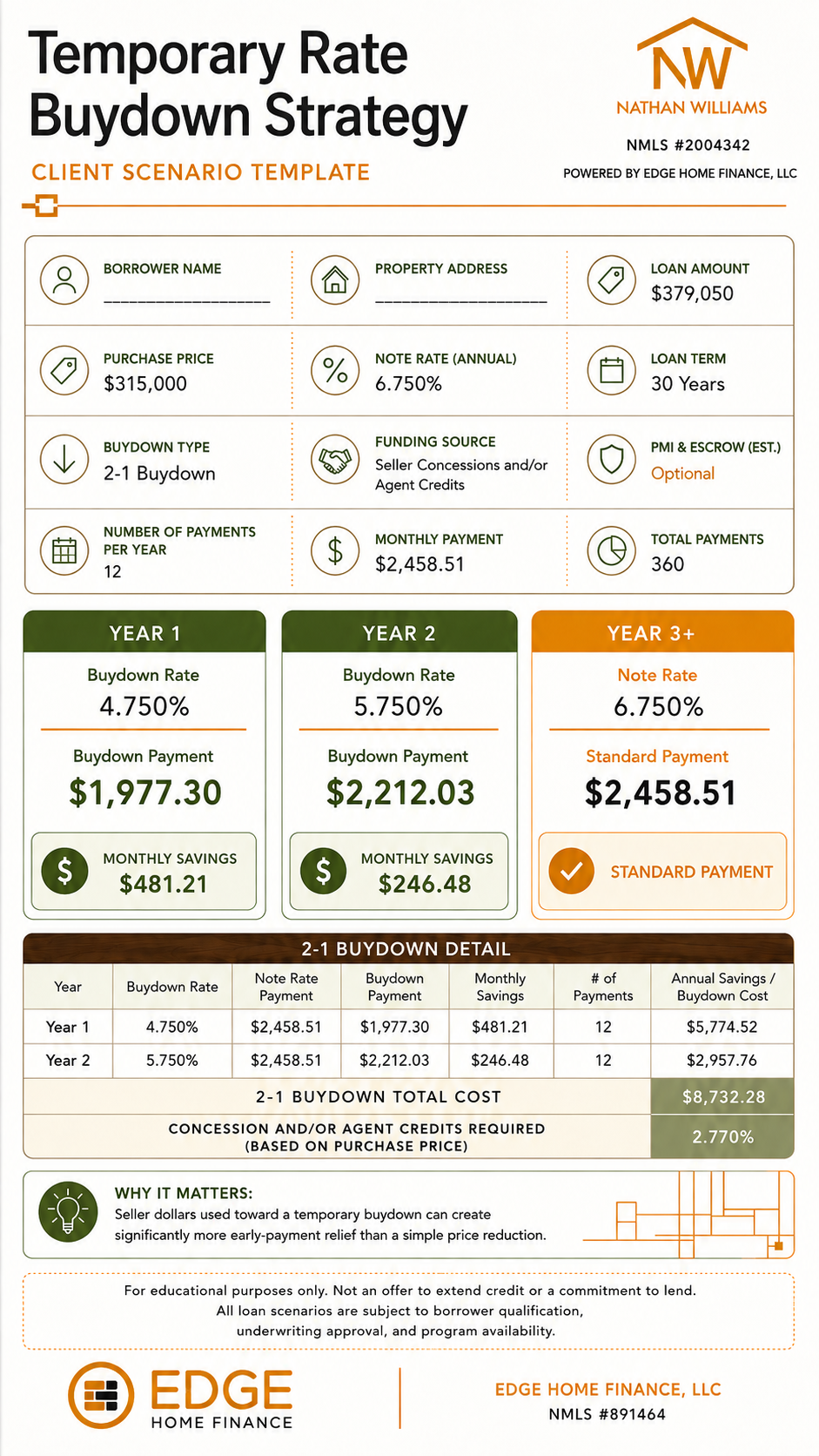
A temporary mortgage-rate buydown can reduce the buyer's payment during the first year or two of homeownership without permanently reducing the agreed-upon purchase price.
What is a temporary rate buydown?
A temporary buydown uses funds contributed at closing to subsidize part of the borrower's mortgage payment for a defined period.
A common example is a 2-1 buydown.
If the underlying note rate were 6.75%, the payment could initially be calculated as though the rate were:
Year 1: 4.75% Year 2: 5.75% Year 3 onward: 6.75%
The actual mortgage still carries the full note rate. Funds placed into a buydown account are used to make up the difference between the reduced payment and the contractual payment.
Another structure is a 1-0 buydown, which reduces the effective payment rate by 1% for the first year.
Why buyers like them
The first year after purchasing a house is expensive.
Moving costs, furniture, repairs and normal life don't disappear simply because you bought a home.
A temporary lower payment can create some breathing room while the buyer gets settled.
And unlike paying discount points to permanently lower a rate, temporary buydown funds aren't necessarily based on the assumption that you'll keep the mortgage for many years.
Why sellers should understand them
Consider a seller contemplating a $10,000 price reduction.
A $10,000 reduction in the sale price may only change the buyer's monthly principal and interest payment by a relatively modest amount.
Using part of that same $10,000 as a properly structured seller concession toward closing costs or a temporary buydown could potentially produce a much larger short-term monthly benefit.
That can make a home meaningfully more affordable without requiring the seller to reduce the price by the same amount.
There's an important qualification rule
A temporary buydown doesn't mean a buyer gets to qualify using the artificially reduced first-year payment.
Generally, the borrower must still qualify based on the contractual mortgage payment under the applicable loan guidelines.
That's important because the payment eventually returns to its full amount.
What happens if rates fall?
Potentially, you refinance.
That's one reason temporary buydowns can be interesting in certain markets.
Rather than spending a large amount of money permanently buying down today's interest rate, a buyer may choose temporary payment relief while retaining the possibility of refinancing later if market conditions improve.
Of course, future rates are never guaranteed and refinancing has costs and qualification requirements.
It isn't always the right answer
Sometimes a price reduction is better.
Sometimes permanent discount points are better.
Sometimes the smartest move is keeping the seller concession for closing costs and preserving the buyer's cash.
The correct answer depends on the buyer's priorities.
That's why I prefer to compare the options in dollars rather than assuming one strategy is automatically better.